CASDW / ACR 2026 Conference: Call for Papers

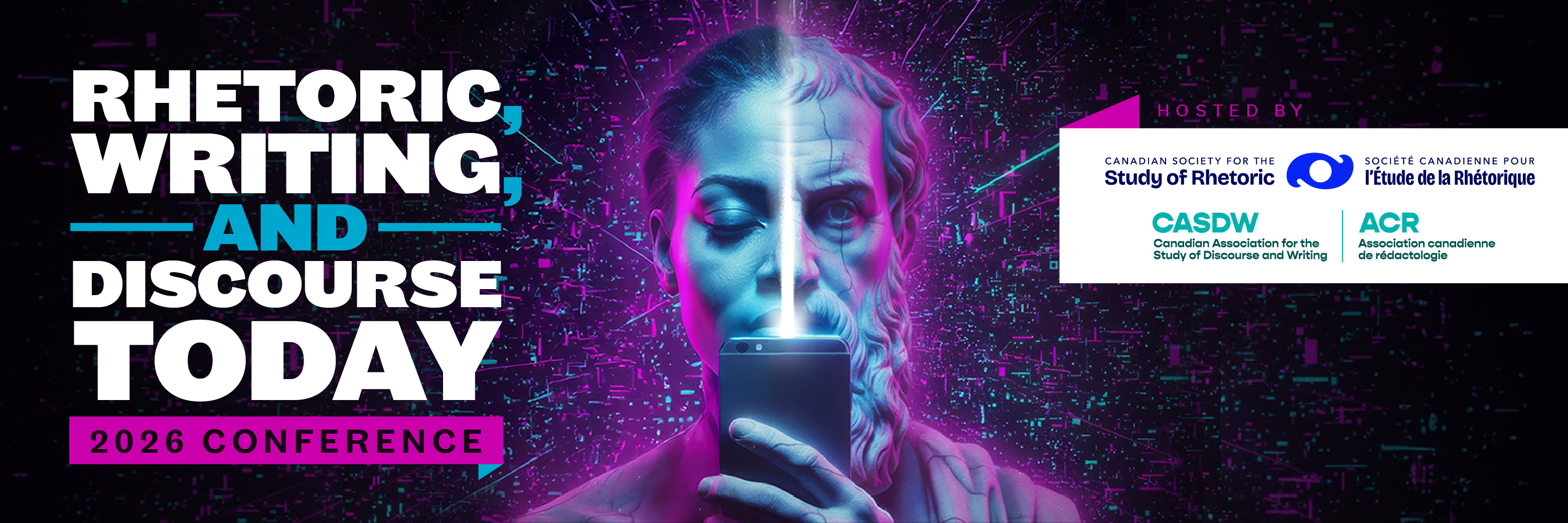
The CASDW/ACR annual conference will be held on 26-28 May 2026 at Saint Jerome’s University in Waterloo, Ontario. Our conference will overlap with the annual conference of RhetCanada, and the two conferences are being collaboratively organized to make for a vibrant 2026 conference experience!

Organizers are planning a sequence of shared CASDW & RhetCanada panels on the conference theme. Registered participants in our CASDW conference will be welcome to attend all RhetCanada sessions, and vice versa. Participants are welcome to submit proposals to both associations; just ensure that the proposals are for distinct presentations, to avoid duplication across the program.

We enthusiastically invite proposals for presentations, roundtables, or workshops, engaging all topics related to writing studies and discourse studies or on our conference theme: Rhetoric, Writing, and Discourse Today. Learn more about CASDW’s Call for Papers here.

In the coming months, watch for updates about early-bird registration, travel arrangements, and more.

Joan Pavelich Dissertation Award for 2024

This year’s winner of the Joan Pavelich Dissertation Award is Mary McCaffery from the University of Toronto, Department of Leadership, Higher, and Adult Education, Ontario Institute for Studies in Education. Mary’s dissertation is titled “Context matters: Exploring teaching methods and contextual factors influencing Ontario grade 12 teachers’ writing instruction.” Using Qualitative methods and interweaving complexity theory, the dissertation asks the following research questions: How do grade 12 English and history teachers teach writing? What composition theories and writing pedagogies influence their teaching? What aspects of teachers’ working contexts influenced their instructional decisions? The findings are organized by complexity theory and the overall thesis concludes that “In many respects, the establishment of education and ongoing professional development in writing pedagogies could result in shared space where secondary and post-secondary educators join a common, less hierarchical, space.” We believe this dissertation fills a gap and contributes to body of literature. We are pleased to present Mary McCaffery with the 2024 Joan Pavelich Dissertation Award.

CASDW Doreen Starke-Meyerring Award

Winning Article:

Natarajan, S. (2024). New Tropes for Old: Changing the Conversation in Canadian Writing Centres. Discourse and Writing/Rédactologie34, 157–182. https://doi.org/10.31468/dwr.1095

Dr. Natarajan’s paper analyzes discursive practices common to Canadian Writing Studies and Writing Center contexts from a radical lens. Anyone in the field can apply the analytical tools provided in this article for curricular review and instructor training. Not only is the article actionable in a variety of contexts, the form and content complement each other.  The writing style reflects the central argument that the figurative language common to our work needs transformation in order to meet the multivalent needs of postsecondary student populations. 

Honourable Mention:

Toorenburgh, L., & Gaudet, L. (2024). Doing our work in a good way: a framework of collaboration and a case for Indigenous-only writing classrooms. Discourse and Writing/Rédactologie34, 200–25. https://doi.org/10.31468/dwr.1049

Dr. Gaudet’s and Lydia Toorenburgh’s article engages the Truth and Reconciliation Commission’s (TRC) Calls to Action by presenting an inclusive and decolonial model for First Year Composition (FYC) courses. The theory and praxis are well developed in the article. The paper is a pleasure to read in structure and clarity. Committee members agreed that the paper opened an honest and poignant conversation about delivering a course for Indigenous students by a non-Indigenous instructor.  The details the authors shared about decolonial course design and implementation provides readers with a roadmap for implementation at their own institutions. 
Calling All Dissertation Survivors (2024)!

The Joan Pavelich CASDW Annual Award for the Best Dissertation in Writing and Discourse Studies recognizes an outstanding PhD dissertation in Writing Studies, Discourse Studies, Rhetoric, or a cognate field for 2024. The award will be given to a student in a Canadian university or to a Canadian student studying outside Canada. To be eligible, dissertations must have been defended between January 1, 2024 and December 31, 2024. An announcement of the winning dissertation will be made at the CASDW Annual Conference. Nominees do not need to be CASDW members, and self-nominations are accepted.

The award includes a prize of $100 and a one-year free CASDW membership for the following year.

The deadline for nominations is March 17, 2025.

The assessment criteria for the award are as follows: (1) the overall quality of the writing and thinking; (2) the significance of the question(s) addressed in the research; (3) the importance of the new knowledge presented in the thesis; and (3) and methodological rigour and/or innovation.

Applicants/nominators should send the following items to each member of the selection committee listed below: a PDF file containing the dissertation (or a link to an online repository), and a cover sheet with the applicant’s full name, citizenship, institution and degree program, and contact information for their primary supervisor.